Fiches › Puissances, racines, exp & log
Puissances, racines, exp & log · niveau renforcé Fonctions exponentielles et logarithmiques Fiche vérifiée par Stéphane Hartmann (ing. EPFL) · Mise à jour : juillet 2026
Fiche de niveau renforcé · Puissances, racines, exp & log · chapitre 5 · 3 notions : Exponentielle naturelle, Logarithme naturel, Relations d’inversion
La méthode 1 📘 Fiche tu es ici 2 🃏 Flashcards 3 🎯 Quiz 4 📝 Examen 📘 Définition ▾ Exponentielle de base a a a
(a > 0 a>0 a > 0 a ≠ 1 a\neq 1 a = 1 f ( x ) = a x f(x)=a^x f ( x ) = a x R \R R R + \Rp R +
Exponentielle naturelle
f ( x ) = e x f(x)=e^x f ( x ) = e x e ≈ 2,71828 e \approx 2{,}71828 e ≈ 2 , 71828
Logarithme de base a a a
(a > 0 a>0 a > 0 a ≠ 1 a\neq 1 a = 1 log a ( x ) \log_a(x) log a ( x ) a x a^x a x
Logarithme naturel
ln ( x ) = log e ( x ) \ln(x)=\log_e(x) ln ( x ) = log e ( x ) e x e^x e x
Relations d’inversion
e x = y ⟺ x = ln ( y ) ( x ∈ R , y > 0 ) , e ln x = x ( x > 0 ) , ln ( e x ) = x ( x ∈ R ) . e^x=y \iff x=\ln(y)\quad (x\in\R,\ y>0),\qquad e^{\ln x}=x\ (x>0),\qquad \ln(e^x)=x\ (x\in\R). e x = y ⟺ x = ln ( y ) ( x ∈ R , y > 0 ) , e l n x = x ( x > 0 ) , ln ( e x ) = x ( x ∈ R ) . Ensembles de définition (ED)
E D ( e x ) = R , E D ( ln x ) = { x ∈ R ∣ x > 0 } . \mathrm{ED}(e^x)=\R,\qquad \mathrm{ED}(\ln x)=\{x\in\R\mid x>0\}. ED ( e x ) = R , ED ( ln x ) = { x ∈ R ∣ x > 0 } . Zéros
e x ≠ 0 pour tout x , ln ( x ) = 0 ⟺ x = 1. e^x\neq 0\ \text{pour tout }x,\qquad \ln(x)=0 \iff x=1. e x = 0 pour tout x , ln ( x ) = 0 ⟺ x = 1. Vocabulaire
croissance/décroissance exponentielle, base, réciproque (inverse), asymptote horizontale/verticale, composition.
Sens de variation selon la base
Si a > 1 a>1 a > 1 a x a^x a x R \R R Si 0 < a < 1 0<a<1 0 < a < 1 a x a^x a x R \R R Propriétés de log a \log_a log a
E D ( log a x ) = ( 0 , + ∞ ) , I m ( log a ) = R , log a ( 1 ) = 0 , log a ( a ) = 1. \mathrm{ED}(\log_a x)=(0,+\infty),\qquad \mathrm{Im}(\log_a)=\R,\qquad \log_a(1)=0,\ \log_a(a)=1. ED ( log a x ) = ( 0 , + ∞ ) , Im ( log a ) = R , log a ( 1 ) = 0 , log a ( a ) = 1. Interprétation :
log a ( y ) \log_a(y) log a ( y ) est l’unique réel
x x x tel que
a x = y a^x=y a x = y (avec
y > 0 y>0 y > 0 ).
Notations usuelles
log ( x ) \log(x) log ( x ) log 10 ( x ) \log_{10}(x) log 10 ( x ) ln ( x ) \ln(x) ln ( x )
🧮 Formules essentielles ▾ Valeurs de base
e 0 = 1 , e 1 = e , ln ( 1 ) = 0 , ln ( e ) = 1. e^0=1,\quad e^1=e,\quad \ln(1)=0,\quad \ln(e)=1. e 0 = 1 , e 1 = e , ln ( 1 ) = 0 , ln ( e ) = 1. Règles sur l’exponentielle
(pour x , y ∈ R x,y\in\R x , y ∈ R n ∈ Z n\in\mathbb{Z} n ∈ Z
e x e y = e x + y , e x e y = e x − y , ( e x ) y = e x y . e^{x}e^{y}=e^{x+y},\qquad \frac{e^{x}}{e^{y}}=e^{x-y},\qquad (e^{x})^{y}=e^{xy}. e x e y = e x + y , e y e x = e x − y , ( e x ) y = e x y . Idée clé :
e A = e B ⟺ A = B e^A=e^B \iff A=B e A = e B ⟺ A = B .
Règles sur le logarithme
(pour x > 0 x>0 x > 0 y > 0 y>0 y > 0 n ∈ R n\in\mathbb{R} n ∈ R
ln ( x y ) = ln x + ln y , ln ( x y ) = ln x − ln y , ln ( x n ) = n ln x ( si x > 0 ) . \ln(xy)=\ln x+\ln y,\qquad \ln\!\left(\frac{x}{y}\right)=\ln x-\ln y,\qquad \ln(x^n)=n\ln x\ \ (\text{si }x>0). ln ( x y ) = ln x + ln y , ln ( y x ) = ln x − ln y , ln ( x n ) = n ln x ( si x > 0 ) . Attention : en réels,
ln ( x n ) \ln(x^n) ln ( x n ) n’a de sens que si
x n > 0 x^n>0 x n > 0 (et la règle
ln ( x n ) = n ln x \ln(x^n)=n\ln x ln ( x n ) = n ln x s’emploie sans risque si
x > 0 x>0 x > 0 ).
Changement de base
(pour a > 0 a>0 a > 0 a ≠ 1 a\neq 1 a = 1 x > 0 x>0 x > 0
log a ( x ) = ln ( x ) ln ( a ) . \log_a(x)=\frac{\ln(x)}{\ln(a)}. log a ( x ) = ln ( a ) ln ( x ) . Dérivées (à connaître)
( e x ) ′ = e x , ( ln x ) ′ = 1 x ( x > 0 ) . (e^x)'=e^x,\qquad (\ln x)'=\frac{1}{x}\ (x>0). ( e x ) ′ = e x , ( ln x ) ′ = x 1 ( x > 0 ) . ( e f ( x ) ) ′ = e f ( x ) f ′ ( x ) , ( ln ( f ( x ) ) ) ′ = f ′ ( x ) f ( x ) ( si f ( x ) > 0 ) . (e^{f(x)})'=e^{f(x)}\,f'(x),\qquad (\ln(f(x)))'=\frac{f'(x)}{f(x)}\ \ (\text{si }f(x)>0). ( e f ( x ) ) ′ = e f ( x ) f ′ ( x ) , ( ln ( f ( x )) ) ′ = f ( x ) f ′ ( x ) ( si f ( x ) > 0 ) . Réécritures très utiles
a x = e x ln ( a ) ( a > 0 ) , log a ( x ) = ln x ln a ( a > 0 , a ≠ 1 , x > 0 ) . a^x=e^{x\ln(a)}\quad (a>0),\qquad \log_a(x)=\frac{\ln x}{\ln a}\quad (a>0,\ a\neq 1,\ x>0). a x = e x l n ( a ) ( a > 0 ) , log a ( x ) = ln a ln x ( a > 0 , a = 1 , x > 0 ) . Conséquence pratique : dès que
log a \log_a log a apparaît, on peut tout ramener à
ln \ln ln .
Dérivées en base a a a
( a x ) ′ = ln ( a ) a x ( a > 0 , a ≠ 1 ) , ( log a x ) ′ = 1 x ln ( a ) ( x > 0 ) . (a^x)'=\ln(a)\,a^x\quad (a>0,\ a\neq 1),
\qquad (\log_a x)'=\frac{1}{x\ln(a)}\quad (x>0). ( a x ) ′ = ln ( a ) a x ( a > 0 , a = 1 ) , ( log a x ) ′ = x ln ( a ) 1 ( x > 0 ) . ( a f ( x ) ) ′ = ln ( a ) a f ( x ) f ′ ( x ) , ( log a ( f ( x ) ) ) ′ = f ′ ( x ) f ( x ) ln ( a ) ( si f ( x ) > 0 ) . (a^{f(x)})'=\ln(a)\,a^{f(x)}\,f'(x),
\qquad (\log_a(f(x)))'=\frac{f'(x)}{f(x)\ln(a)}\ \ (\text{si }f(x)>0). ( a f ( x ) ) ′ = ln ( a ) a f ( x ) f ′ ( x ) , ( log a ( f ( x )) ) ′ = f ( x ) ln ( a ) f ′ ( x ) ( si f ( x ) > 0 ) . Limites fondamentales et asymptotes
lim x → − ∞ e x = 0 ( AH : y = 0 a ˋ gauche ) , lim x → + ∞ e x = + ∞ . \lim_{x\to-\infty} e^x=0 \quad(\text{AH : }y=0 \text{ à gauche}),\qquad \lim_{x\to+\infty} e^x=+\infty. x → − ∞ lim e x = 0 ( AH : y = 0 a ˋ gauche ) , x → + ∞ lim e x = + ∞. lim x → 0 + ln x = − ∞ ( AV : x = 0 ) , lim x → + ∞ ln x = + ∞ . \lim_{x\to 0^+}\ln x=-\infty \quad(\text{AV : }x=0),\qquad \lim_{x\to+\infty}\ln x=+\infty. x → 0 + lim ln x = − ∞ ( AV : x = 0 ) , x → + ∞ lim ln x = + ∞. Croissances comparées (règle du podium, utile en limites)
pour tout n ∈ N : lim x → + ∞ e x x n = + ∞ , lim x → + ∞ x n e x = 0 , \text{pour tout }n\in\mathbb{N}:\quad \lim_{x\to+\infty}\frac{e^x}{x^n}=+\infty,\qquad \lim_{x\to+\infty}\frac{x^n}{e^x}=0, pour tout n ∈ N : x → + ∞ lim x n e x = + ∞ , x → + ∞ lim e x x n = 0 , pour tout n ∈ N : lim x → + ∞ ln x x n = 0 , lim x → + ∞ x n ln x = + ∞ . \text{pour tout }n\in\mathbb{N}:\quad \lim_{x\to+\infty}\frac{\ln x}{x^n}=0,\qquad \lim_{x\to+\infty}\frac{x^n}{\ln x}=+\infty. pour tout n ∈ N : x → + ∞ lim x n ln x = 0 , x → + ∞ lim ln x x n = + ∞. Limites de référence (très fréquentes)
lim x → 0 e x − 1 x = 1 , lim x → 0 ln ( 1 + x ) x = 1. \lim_{x\to 0}\frac{e^x-1}{x}=1,\qquad \lim_{x\to 0}\frac{\ln(1+x)}{x}=1. x → 0 lim x e x − 1 = 1 , x → 0 lim x ln ( 1 + x ) = 1. Astuce : ces limites servent à reconnaître des « formes standard » via une substitution.
(Renforcé) Approximations locales (ordre 1) et tangentes
e x ≈ 1 + x ( x ≈ 0 ) , ln ( 1 + x ) ≈ x ( x ≈ 0 ) . e^x \approx 1+x\ (x\approx 0),\qquad \ln(1+x)\approx x\ (x\approx 0). e x ≈ 1 + x ( x ≈ 0 ) , ln ( 1 + x ) ≈ x ( x ≈ 0 ) . Lecture : ce sont les tangentes en
0 0 0 pour
e x e^x e x et en
0 0 0 pour
ln ( 1 + x ) \ln(1+x) ln ( 1 + x ) .
Inégalités classiques (convexité/concavité)
e x ≥ 1 + x ( ∀ x ∈ R ) , ln x ≤ x − 1 ( x > 0 ) , e^x\ge 1+x\ \ (\forall x\in\R),\qquad \ln x \le x-1\ \ (x>0), e x ≥ 1 + x ( ∀ x ∈ R ) , ln x ≤ x − 1 ( x > 0 ) , avec égalité seulement pour
x = 0 x=0 x = 0 dans la première et
x = 1 x=1 x = 1 dans la seconde.
Règle de Bernoulli--L'Hospital (B--H)
Si lim x → a f ( x ) g ( x ) est de type 0 0 ou ± ∞ ± ∞ , alors lim x → a f ( x ) g ( x ) = lim x → a f ′ ( x ) g ′ ( x ) \text{Si }\ \lim_{x\to a}\frac{f(x)}{g(x)}\ \text{est de type}\ \frac{0}{0}\ \text{ou}\ \frac{\pm\infty}{\pm\infty},
\ \text{alors}\
\lim_{x\to a}\frac{f(x)}{g(x)}=\lim_{x\to a}\frac{f'(x)}{g'(x)} Si x → a lim g ( x ) f ( x ) est de type 0 0 ou ± ∞ ± ∞ , alors x → a lim g ( x ) f ( x ) = x → a lim g ′ ( x ) f ′ ( x ) à condition que
f , g f,g f , g soient dérivables près de
a a a ,
g ′ ( x ) ≠ 0 g'(x)\neq 0 g ′ ( x ) = 0 près de
a a a , et que la limite du quotient des dérivées existe (éventuellement
± ∞ \pm\infty ± ∞ ).
Remarque : on peut appliquer B--H plusieurs fois si nécessaire.
Asymptote oblique / droite d’approximation
Si m = lim x → ± ∞ f ( x ) x existe, alors on tente y = m x + h avec h = lim x → ± ∞ ( f ( x ) − m x ) . \text{Si }m=\lim_{x\to\pm\infty}\frac{f(x)}{x}\ \text{existe, alors on tente}\ y=mx+h\ \text{avec}\
h=\lim_{x\to\pm\infty}\big(f(x)-mx\big). Si m = x → ± ∞ lim x f ( x ) existe, alors on tente y = m x + h avec h = x → ± ∞ lim ( f ( x ) − m x ) . Idée : écrire
f ( x ) = m x + h + δ ( x ) f(x)=mx+h+\delta(x) f ( x ) = m x + h + δ ( x ) avec
lim x → ± ∞ δ ( x ) = 0 \lim_{x\to\pm\infty}\delta(x)=0 lim x → ± ∞ δ ( x ) = 0 .
🛠️ Méthodes ▾ Pour résoudre une équation exponentielle (avec e e e
Mettre l’équation sous la forme e A ( x ) = k e^{A(x)}=k e A ( x ) = k k > 0 k>0 k > 0 Appliquer ln \ln ln A ( x ) = ln ( k ) A(x)=\ln(k) A ( x ) = ln ( k ) Résoudre l’équation obtenue et vérifier. Pour résoudre une équation logarithmique
Déterminer l’ED : imposer toutes les conditions ( argument de ln > 0 ) \,(\text{argument de }\ln>0) ( argument de ln > 0 ) Simplifier avec les règles (produit/quotient/puissance) si utile. Passer à l’exponentielle : si ln ( U ) = c \ln(U)=c ln ( U ) = c U = e c U=e^c U = e c Résoudre puis éliminer les solutions hors ED. Pour résoudre une inéquation avec ln \ln ln e x e^x e x
Utiliser la monotonie stricte de e x e^x e x ln x \ln x ln x
Écrire l’ED (si ln \ln ln
Utiliser la monotonie :
e x e^x e x R \R R ln x \ln x ln x ( 0 , + ∞ ) (0,+\infty) ( 0 , + ∞ ) Ainsi, on peut comparer les arguments :
e A ( x ) ≤ e B ( x ) ⟺ A ( x ) ≤ B ( x ) , ln ( U ) ≤ ln ( V ) ⟺ U ≤ V ( U , V > 0 ) . e^{A(x)}\le e^{B(x)} \iff A(x)\le B(x),\qquad \ln(U)\le \ln(V) \iff U\le V\ (U,V>0). e A ( x ) ≤ e B ( x ) ⟺ A ( x ) ≤ B ( x ) , ln ( U ) ≤ ln ( V ) ⟺ U ≤ V ( U , V > 0 ) . Pour dériver une fonction contenant
e f ( x ) e^{f(x)} e f ( x ) ln ( f ( x ) ) \ln(f(x)) ln ( f ( x ))
Identifier la forme (composition, produit, quotient). Appliquer les règles usuelles : produit, quotient, chaîne. Pour ln ( f ( x ) ) \ln(f(x)) ln ( f ( x )) f ( x ) > 0 f(x)>0 f ( x ) > 0 Pour calculer une limite « type podium »
Réécrire la limite sous forme de quotient, p.ex. x 2 e − x = x 2 e x x^2e^{-x}=\dfrac{x^2}{e^x} x 2 e − x = e x x 2 Utiliser l’ordre de dominance à + ∞ +\infty + ∞
ln ( x ) ≪ x n ≪ e x ( n ∈ N ) . \ln(x)\ \ll\ x^n\ \ll\ e^x\qquad (n\in\mathbb{N}). ln ( x ) ≪ x n ≪ e x ( n ∈ N ) . Conclure : polynôme sur exponentielle → 0 \to 0 → 0 → + ∞ \to +\infty → + ∞ Pour résoudre une équation exponentielle en base a a a
Mettre sous la forme a A ( x ) = k a^{A(x)}=k a A ( x ) = k a > 0 a>0 a > 0 a ≠ 1 a\neq 1 a = 1 k > 0 k>0 k > 0 Appliquer ln \ln ln A ( x ) ln ( a ) = ln ( k ) A(x)\ln(a)=\ln(k) A ( x ) ln ( a ) = ln ( k ) A ( x ) = ln ( k ) ln ( a ) A(x)=\dfrac{\ln(k)}{\ln(a)} A ( x ) = ln ( a ) ln ( k ) Résoudre et vérifier (notamment k > 0 k>0 k > 0 Pour résoudre une équation du type
A ( x ) B ( x ) = C ( x ) A(x)^{B(x)}=C(x) A ( x ) B ( x ) = C ( x )
Imposer A ( x ) > 0 A(x)>0 A ( x ) > 0 ln \ln ln Prendre ln \ln ln B ( x ) ln ( A ( x ) ) = ln ( C ( x ) ) B(x)\ln(A(x))=\ln(C(x)) B ( x ) ln ( A ( x )) = ln ( C ( x )) C ( x ) > 0 C(x)>0 C ( x ) > 0 Résoudre l’équation obtenue puis contrôler l’ED. Pour une inéquation avec a x a^x a x 0 < a < 1 0<a<1 0 < a < 1
Identifier que a x a^x a x Comparer les exposants en renversant le sens :
a A ( x ) ≤ a B ( x ) ⟺ A ( x ) ≥ B ( x ) ( 0 < a < 1 ) . a^{A(x)}\le a^{B(x)}\iff A(x)\ge B(x)\qquad (0<a<1). a A ( x ) ≤ a B ( x ) ⟺ A ( x ) ≥ B ( x ) ( 0 < a < 1 ) . Pour une limite en indétermination
0 0 \frac{0}{0} 0 0 ∞ ∞ \frac{\infty}{\infty} ∞ ∞
Vérifier la forme : numérateur et dénominateur → 0 \to 0 → 0 → ± ∞ \to \pm\infty → ± ∞ Dériver numérateur et dénominateur, puis recalculer la limite. Répéter si nécessaire (tant qu’on reste dans une forme indéterminée). Pour déterminer une asymptote oblique y = m x + h y=mx+h y = m x + h
Calculer m = lim x → ± ∞ f ( x ) x m=\displaystyle \lim_{x\to\pm\infty}\frac{f(x)}{x} m = x → ± ∞ lim x f ( x ) Calculer h = lim x → ± ∞ ( f ( x ) − m x ) h=\displaystyle \lim_{x\to\pm\infty}\big(f(x)-mx\big) h = x → ± ∞ lim ( f ( x ) − m x ) Conclure : si δ ( x ) = f ( x ) − ( m x + h ) → 0 \delta(x)=f(x)-(mx+h)\to 0 δ ( x ) = f ( x ) − ( m x + h ) → 0 y = m x + h y=mx+h y = m x + h Pour étudier une fonction avec ln ( ⋅ ) \ln(\cdot) ln ( ⋅ )
ED : imposer tous les arguments de ln \ln ln Limites aux bornes de l’ED : souvent x → 0 + x\to 0^+ x → 0 + x → + ∞ x\to +\infty x → + ∞ Dérivée : utiliser ( ln ( f ( x ) ) ) ′ = f ′ ( x ) f ( x ) \big(\ln(f(x))\big)'=\dfrac{f'(x)}{f(x)} ( ln ( f ( x )) ) ′ = f ( x ) f ′ ( x ) f ( x ) > 0 f(x)>0 f ( x ) > 0 Signe de f ′ ( x ) f'(x) f ′ ( x ) f ′ ′ f'' f ′′ 📈 Interprétations et graphiques ▾ Monotonie et image
e x e^x e x R \R R e x > 0 e^x>0 e x > 0 ln x \ln x ln x ( 0 , + ∞ ) (0,+\infty) ( 0 , + ∞ ) ln x < 0 \ln x<0 ln x < 0 0 < x < 1 0<x<1 0 < x < 1 ln x > 0 \ln x>0 ln x > 0 x > 1 x>1 x > 1 Points repères
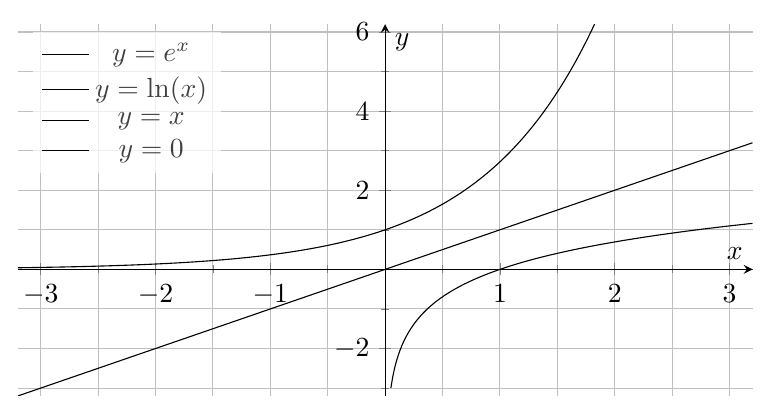
e 0 = 1 ⇒ ( 0 , 1 ) ∈ C e x , ln ( 1 ) = 0 ⇒ ( 1 , 0 ) ∈ C ln x . e^0=1 \Rightarrow (0,1)\in \mathcal{C}_{e^x},\qquad \ln(1)=0 \Rightarrow (1,0)\in \mathcal{C}_{\ln x}. e 0 = 1 ⇒ ( 0 , 1 ) ∈ C e x , ln ( 1 ) = 0 ⇒ ( 1 , 0 ) ∈ C l n x . Asymptotes
Pour e x e^x e x y = 0 y=0 y = 0 x → − ∞ x\to-\infty x → − ∞ Pour ln x \ln x ln x x = 0 x=0 x = 0 x → 0 + x\to 0^+ x → 0 + Lien réciproque
Les courbes de y = e x y=e^x y = e x y = ln x y=\ln x y = ln x y = x y=x y = x Convexité / concavité (lecture graphique)
e x e^x e x R \R R e x ≥ 1 + x e^x\ge 1+x e x ≥ 1 + x ln x \ln x ln x ( 0 , + ∞ ) (0,+\infty) ( 0 , + ∞ ) ln x ≤ x − 1 \ln x\le x-1 ln x ≤ x − 1 Impact de la base a a a a x a^x a x
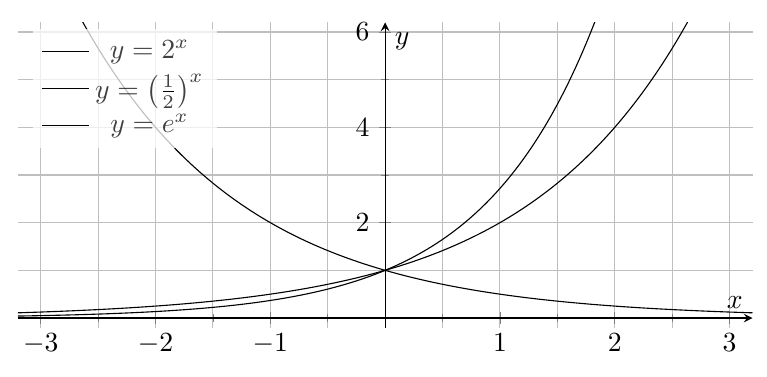
Toutes les courbes passent par ( 0 , 1 ) (0,1) ( 0 , 1 ) Si a > 1 a>1 a > 1 a a a Si 0 < a < 1 0<a<1 0 < a < 1 a x = ( 1 a ) − x a^x=\left(\frac{1}{a}\right)^{-x} a x = ( a 1 ) − x Exemple (graphique)
[Voir graphique dans la fiche complète]
Lecture rapide
À gauche, e x e^x e x 0 0 0 Près de 0 + 0^+ 0 + ln x \ln x ln x − ∞ -\infty − ∞ L’intersection avec y = x y=x y = x Graphe comparatif de a x a^x a x
[Voir graphique dans la fiche complète]
✏️ Exemples-types ▾ Équations simples avec ln \ln ln e x e^x e x
Résoudre ln ( x − 2 ) = 4 \ln(x-2)=4 ln ( x − 2 ) = 4 ED : x − 2 > 0 ⇒ x > 2 x-2>0 \Rightarrow x>2 x − 2 > 0 ⇒ x > 2 ln ( x − 2 ) = 4 ⟺ x − 2 = e 4 ⟺ x = 2 + e 4 \ln(x-2)=4 \iff x-2=e^4 \iff x=2+e^4 ln ( x − 2 ) = 4 ⟺ x − 2 = e 4 ⟺ x = 2 + e 4 2 + e 4 > 2 2+e^4>2 2 + e 4 > 2 x = 2 + e 4 x=2+e^4 x = 2 + e 4
Résoudre e x + 4 = 5 e^{x+4}=5 e x + 4 = 5 Comme 5 > 0 5>0 5 > 0 ln \ln ln x + 4 = ln ( 5 ) x+4=\ln(5) x + 4 = ln ( 5 ) x = ln ( 5 ) − 4 x=\ln(5)-4 x = ln ( 5 ) − 4 x = ln ( 5 ) − 4 x=\ln(5)-4 x = ln ( 5 ) − 4
Variante : résoudre 10 x = 7 10^x=7 1 0 x = 7 10 x = e x ln ( 10 ) 10^x=e^{x\ln(10)} 1 0 x = e x l n ( 10 ) 7 > 0 7>0 7 > 0
10 x = 7 ⟺ x ln ( 10 ) = ln ( 7 ) ⟺ x = ln ( 7 ) ln ( 10 ) = log 10 ( 7 ) . 10^x=7 \iff x\ln(10)=\ln(7)\iff x=\frac{\ln(7)}{\ln(10)}=\log_{10}(7). 1 0 x = 7 ⟺ x ln ( 10 ) = ln ( 7 ) ⟺ x = ln ( 10 ) ln ( 7 ) = log 10 ( 7 ) . Solution :
x = ln ( 7 ) ln ( 10 ) x=\dfrac{\ln(7)}{\ln(10)} x = ln ( 10 ) ln ( 7 ) .
Variante : résoudre 3 2 x − 1 = 5 3^{2x-1}=5 3 2 x − 1 = 5 Comme 5 > 0 5>0 5 > 0
3 2 x − 1 = 5 ⟺ ( 2 x − 1 ) ln ( 3 ) = ln ( 5 ) ⟺ 2 x − 1 = ln ( 5 ) ln ( 3 ) . 3^{2x-1}=5 \iff (2x-1)\ln(3)=\ln(5)\iff 2x-1=\frac{\ln(5)}{\ln(3)}. 3 2 x − 1 = 5 ⟺ ( 2 x − 1 ) ln ( 3 ) = ln ( 5 ) ⟺ 2 x − 1 = ln ( 3 ) ln ( 5 ) . S o l u t i o n : x = 1 2 ( 1 + ln ( 5 ) ln ( 3 ) ) . Solution :\quad x=\frac12\left(1+\frac{\ln(5)}{\ln(3)}\right). S o l u t i o n : x = 2 1 ( 1 + ln ( 3 ) ln ( 5 ) ) . Équation logarithmique (avec ED) :
ln ( x + 3 ) = ln ( 2 x + 7 ) . \ln(x+3)=\ln(2x+7). ln ( x + 3 ) = ln ( 2 x + 7 ) . ED :
x + 3 > 0 x+3>0 x + 3 > 0 et
2 x + 7 > 0 ⇒ x > − 3 2x+7>0 \Rightarrow x>-3 2 x + 7 > 0 ⇒ x > − 3 et
x > − 7 2 x>-\tfrac{7}{2} x > − 2 7 , donc
x > − 3 x>-3 x > − 3 .
Comme
ln \ln ln est injective sur
( 0 , + ∞ ) (0,+\infty) ( 0 , + ∞ ) :
ln ( x + 3 ) = ln ( 2 x + 7 ) ⟺ x + 3 = 2 x + 7 ⟺ x = − 4. \ln(x+3)=\ln(2x+7)\iff x+3=2x+7 \iff x=-4. ln ( x + 3 ) = ln ( 2 x + 7 ) ⟺ x + 3 = 2 x + 7 ⟺ x = − 4. Or
− 4 ≯ − 3 -4\not>-3 − 4 > − 3 , donc aucune solution.
Conclusion :
∅ \varnothing ∅ .
Équation avec quotient dans le logarithme
ln ( x + 3 2 − x ) = 0. \ln\!\left(\frac{x+3}{2-x}\right)=0. ln ( 2 − x x + 3 ) = 0. ED : il faut
x + 3 2 − x > 0 \dfrac{x+3}{2-x}>0 2 − x x + 3 > 0 et
2 − x ≠ 0 2-x\neq 0 2 − x = 0 .
Étude de signe (points critiques :
x = − 3 x=-3 x = − 3 et
x = 2 x=2 x = 2 ) :
x + 3 2 − x > 0 ⟺ − 3 < x < 2. \frac{x+3}{2-x}>0 \iff -3<x<2. 2 − x x + 3 > 0 ⟺ − 3 < x < 2. Résolution :
ln ( x + 3 2 − x ) = 0 ⟺ x + 3 2 − x = e 0 = 1 ⟺ x + 3 = 2 − x ⟺ 2 x = − 1 ⟺ x = − 1 2 . \ln\!\left(\frac{x+3}{2-x}\right)=0 \iff \frac{x+3}{2-x}=e^0=1
\iff x+3=2-x \iff 2x=-1 \iff x=-\frac12. ln ( 2 − x x + 3 ) = 0 ⟺ 2 − x x + 3 = e 0 = 1 ⟺ x + 3 = 2 − x ⟺ 2 x = − 1 ⟺ x = − 2 1 . Vérification :
− 1 2 ∈ ( − 3 , 2 ) -\frac12\in(-3,2) − 2 1 ∈ ( − 3 , 2 ) donc OK.
Solution :
x = − 1 2 x=-\dfrac12 x = − 2 1 .
Dérivée (produit + chaîne) et conséquence sur le signe
f ( x ) = ( x 2 + x + 1 ) e − 2 x . f(x)=(x^2+x+1)\,e^{-2x}. f ( x ) = ( x 2 + x + 1 ) e − 2 x . Dérivation (produit) :
f ′ ( x ) = ( 2 x + 1 ) e − 2 x + ( x 2 + x + 1 ) ( e − 2 x ) ′ . f'(x)=(2x+1)e^{-2x}+(x^2+x+1)\,(e^{-2x})'. f ′ ( x ) = ( 2 x + 1 ) e − 2 x + ( x 2 + x + 1 ) ( e − 2 x ) ′ . Or
( e − 2 x ) ′ = e − 2 x ⋅ ( − 2 ) (e^{-2x})'=e^{-2x}\cdot(-2) ( e − 2 x ) ′ = e − 2 x ⋅ ( − 2 ) , donc
f ′ ( x ) = e − 2 x ( ( 2 x + 1 ) − 2 ( x 2 + x + 1 ) ) = e − 2 x ( − 2 x 2 − 1 ) . f'(x)=e^{-2x}\Big((2x+1)-2(x^2+x+1)\Big)
=e^{-2x}\big(-2x^2-1\big). f ′ ( x ) = e − 2 x ( ( 2 x + 1 ) − 2 ( x 2 + x + 1 ) ) = e − 2 x ( − 2 x 2 − 1 ) . Comme
e − 2 x > 0 e^{-2x}>0 e − 2 x > 0 et
− 2 x 2 − 1 < 0 -2x^2-1<0 − 2 x 2 − 1 < 0 pour tout
x x x , on a
f ′ ( x ) < 0 f'(x)<0 f ′ ( x ) < 0 sur
R \R R .
Conclusion :
f f f est strictement décroissante sur
R \R R .
Règle de Bernoulli--L'Hospital
Calculer
lim x → 2 x 2 − 4 e x − 2 − 1 . \lim_{x\to 2}\frac{x^2-4}{e^{x-2}-1}. x → 2 lim e x − 2 − 1 x 2 − 4 . On a une indétermination
0 0 \frac{0}{0} 0 0 , donc B--H :
lim x → 2 x 2 − 4 e x − 2 − 1 = lim x → 2 ( x 2 − 4 ) ′ ( e x − 2 − 1 ) ′ = lim x → 2 2 x e x − 2 = 4 1 = 4. \lim_{x\to 2}\frac{x^2-4}{e^{x-2}-1}
=\lim_{x\to 2}\frac{(x^2-4)'}{(e^{x-2}-1)'}
=\lim_{x\to 2}\frac{2x}{e^{x-2}}
=\frac{4}{1}=4. x → 2 lim e x − 2 − 1 x 2 − 4 = x → 2 lim ( e x − 2 − 1 ) ′ ( x 2 − 4 ) ′ = x → 2 lim e x − 2 2 x = 1 4 = 4. ⚠️ Pièges et cas particuliers ▾ Oublier l’ED
dans toute équation/inéquation avec ln ( ⋅ ) \ln(\cdot) ln ( ⋅ ) > 0 >0 > 0 ≠ 0 \neq 0 = 0
Mauvaise simplification
ln ( x + y ) ≠ ln x + ln y \ln(x+y)\neq \ln x+\ln y ln ( x + y ) = ln x + ln y (faux !)
Les seules règles sont produit/quotient/puissance (avec conditions).
Puissance dans le log
ln ( x 2 ) = 2 ln x \ln(x^2)=2\ln x ln ( x 2 ) = 2 ln x x > 0 x>0 x > 0 ln x \ln x ln x
Confusion inverse / opposé
ln ( e x ) = x (toujours) , e ln x = x seulement si x > 0. \ln(e^x)=x \ \text{(toujours)},\qquad e^{\ln x}=x \ \text{seulement si }x>0. ln ( e x ) = x (toujours) , e l n x = x seulement si x > 0. Exponentielle toujours positive
e x > 0 e^x>0 e x > 0 e A ( x ) = k e^{A(x)}=k e A ( x ) = k k ≤ 0 k\le 0 k ≤ 0
Inéquations : attention au sens
Avec e x e^x e x ln x \ln x ln x e e e Avec a x a^x a x 0 < a < 1 0<a<1 0 < a < 1 Limites
transformer x n e − x x^n e^{-x} x n e − x x n e x \dfrac{x^n}{e^x} e x x n
Dérivée de ln ( f ( x ) ) \ln(f(x)) ln ( f ( x ))
oublier la condition f ( x ) > 0 f(x)>0 f ( x ) > 0
B--H : ne pas l’appliquer « par réflexe »
B--H s’applique uniquement aux formes 0 0 \frac{0}{0} 0 0 ∞ ∞ \frac{\infty}{\infty} ∞ ∞ Vérifier que g ′ ( x ) ≠ 0 g'(x)\neq 0 g ′ ( x ) = 0 Approximations : ne pas les transformer en égalités exactes
e x ≈ 1 + x (pr e ˋ s de 0) ne signifie pas e x = 1 + x . e^x\approx 1+x \ \text{(près de 0) ne signifie pas}\ e^x=1+x. e x ≈ 1 + x (pr e ˋ s de 0) ne signifie pas e x = 1 + x . Même vigilance pour
ln ( 1 + x ) ≈ x \ln(1+x)\approx x ln ( 1 + x ) ≈ x .
Asymptote oblique : deux limites à faire
Trouver m m m h h h f ( x ) − ( m x + h ) → 0 f(x)-(mx+h)\to 0 f ( x ) − ( m x + h ) → 0 Ne pas confondre « droite d’approximation » et « égalité ». ln \ln ln
En réels : ln ( x ) \ln(x) ln ( x ) x ≤ 0 x\le 0 x ≤ 0 Les expressions comme ln ( x 2 ) \ln(x^2) ln ( x 2 ) x ≠ 0 x\neq 0 x = 0 2 ln ( x ) 2\ln(x) 2 ln ( x ) x < 0 x<0 x < 0 ✅ À retenir ▾ Je connais l’ED de e x e^x e x ln x \ln x ln x
Je sais utiliser e x = y ⟺ x = ln y e^x=y \iff x=\ln y e x = y ⟺ x = ln y y > 0 y>0 y > 0
Je maîtrise les règles : ln ( x y ) \ln(xy) ln ( x y ) ln ( x / y ) \ln(x/y) ln ( x / y ) ln ( x n ) \ln(x^n) ln ( x n )
Je sais résoudre e A ( x ) = k e^{A(x)}=k e A ( x ) = k ln \ln ln k > 0 k>0 k > 0
Je sais résoudre ln ( U ) = c \ln(U)=c ln ( U ) = c U = e c U=e^c U = e c U > 0 U>0 U > 0
Je sais résoudre une équation ln ( U ) = ln ( V ) \ln(U)=\ln(V) ln ( U ) = ln ( V ) U > 0 U>0 U > 0 V > 0 V>0 V > 0
Je connais : ( e x ) ′ = e x (e^x)'=e^x ( e x ) ′ = e x ( ln x ) ′ = 1 / x (\ln x)'=1/x ( ln x ) ′ = 1/ x
Je sais dériver e f ( x ) e^{f(x)} e f ( x ) ln ( f ( x ) ) \ln(f(x)) ln ( f ( x ))
Je sais lire les asymptotes : y = 0 y=0 y = 0 e x e^x e x x = 0 x=0 x = 0 ln x \ln x ln x
Je sais utiliser la règle du podium : ln ( x ) ≪ x n ≪ e x \ln(x)\ll x^n \ll e^x ln ( x ) ≪ x n ≪ e x x → + ∞ x\to+\infty x → + ∞
Je sais ramener a x a^x a x log a \log_a log a ln \ln ln a x = e x ln ( a ) a^x=e^{x\ln(a)} a x = e x l n ( a ) log a ( x ) = ln x ln a \log_a(x)=\dfrac{\ln x}{\ln a} log a ( x ) = ln a ln x
Je connais ( a x ) ′ = ln ( a ) a x (a^x)'=\ln(a)a^x ( a x ) ′ = ln ( a ) a x ( log a x ) ′ = 1 x ln ( a ) (\log_a x)'=\dfrac{1}{x\ln(a)} ( log a x ) ′ = x ln ( a ) 1
Je sais quand une inéquation se renverse (cas 0 < a < 1 0<a<1 0 < a < 1
Je reconnais une indétermination 0 0 \frac{0}{0} 0 0 ∞ ∞ \frac{\infty}{\infty} ∞ ∞
Je sais déterminer une asymptote oblique en calculant m = lim f ( x ) x m=\lim \frac{f(x)}{x} m = lim x f ( x ) h = lim ( f ( x ) − m x ) h=\lim(f(x)-mx) h = lim ( f ( x ) − m x )
Je connais les approximations : e x ≈ 1 + x e^x\approx 1+x e x ≈ 1 + x ln ( 1 + x ) ≈ x \ln(1+x)\approx x ln ( 1 + x ) ≈ x 0 0 0
🃏 Étape suivante Flashcards : Puissances, racines, exp & log Mémorise les définitions et formules de ce chapitre, carte par carte. → Ce chapitre t'attend en mode entraînement Flashcards, QCM corrigés et suivi de progression sur ce chapitre, la méthode complète, dans MatuMath.
← Fiche précédente Fonctions exponentielles et logarithmiques : niveau standard Autres fiches : Puissances, racines, exp & log
Voir aussi toutes les fiches de Puissances, racines, exp & log · les flashcards Puissances, racines, exp & log · les QCM corrigés de Puissances, racines, exp & log
· les examens de maturité corrigés
· le lexique .